How to Choose the Best Amplifier Audio Board at Canton Fair 2026?
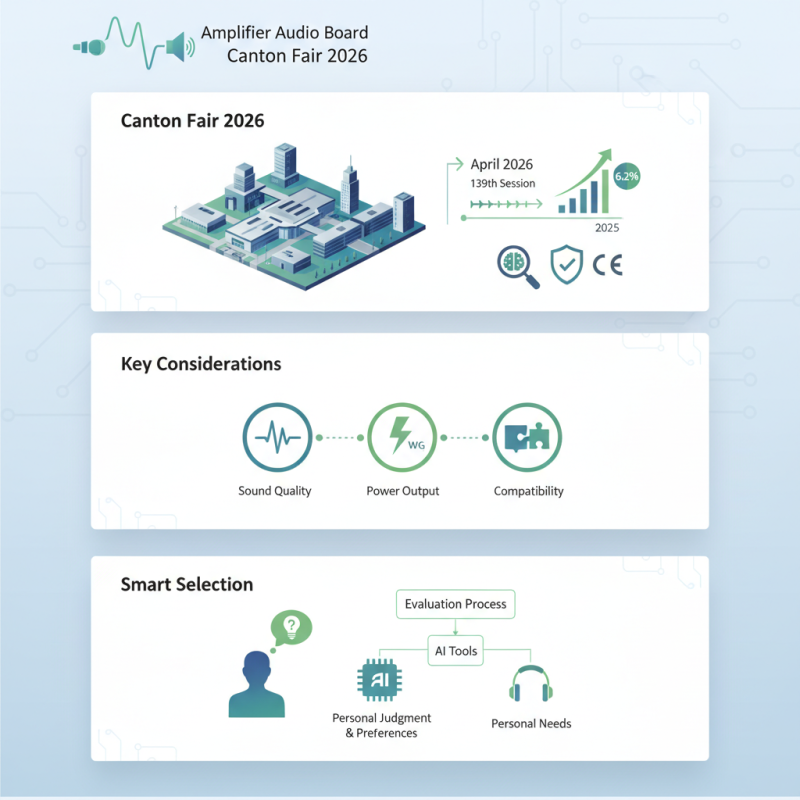
As the 139th Canton Fair approaches in April 2026, attendees will focus on cutting-edge products, including the Amplifier Audio Board. The audio equipment industry continues to grow, with a projected CAGR of 6.2% until 2025, according to industry reports.
This year's fair will introduce AI-driven search features, enhancing the experience for buyers. Participants can quickly find suppliers with specific certifications, such as ISO and CE, fostering a more efficient selection process. The fair spans 1.55 million square meters, allowing ample space to explore diverse audio products.
Choosing the right Amplifier Audio Board involves considering sound quality, power output, and compatibility. With many options available, careful evaluation is essential. The AI tools may streamline the process, but personal judgment will always remain crucial. The insights gained may spark reflection on personal preferences and needs in audio technology.
Choosing the Right Amplifier: Key Specifications to Evaluate
When attending the Canton Fair 2026, selecting the right amplifier audio board can be challenging. It’s crucial to focus on key specifications. Begin by examining power output. Look for a wattage that fits your needs. Higher wattage can deliver louder sounds, but it may also require better speakers. Match your amplifier carefully.
Next, consider impedance ratings. Common values are 4, 6, or 8 ohms. An amplifier's impedance must match your speakers. This ensures efficiency and sound clarity. Don't overlook total harmonic distortion (THD). A lower percentage means cleaner sound. Aim for an amplifier with under 0.1% THD for clarity.
Also, check for connectivity options. Bluetooth and Wi-Fi capabilities can enhance convenience. Many boards have multiple inputs. This is helpful if you connect various devices. If possible, test the board live. Listening is vital; specifications alone can't tell you everything. Try to recall what you liked and didn’t like. It's an imperfect process, but finding the best fit is worth it.
Understanding Amplifier Power Ratings: Watts, RMS, and THD
When choosing an amplifier audio board, understanding power ratings is essential. Watts, RMS (Root Mean Square), and THD (Total Harmonic Distortion) are key metrics. Watts indicate the amplifier's output power. Higher wattage generally means louder sound, but it isn't the only indicator of quality.
RMS is crucial for assessing true power. It reflects the continuous power an amplifier can deliver. Reports show that many users overlook this. For instance, an amplifier rated at 100 watts peak may produce only 50 watts RMS. This can lead to dissatisfaction, especially in larger setups.
THD measures audio distortion. It's typically presented as a percentage, indicating how much the sound deviates from the original. A lower THD means clearer audio. Research suggests many audiophiles look for THD ratings below 1% for optimal listening. However, subjective listening tests often reveal varied personal preferences. Balancing these ratings is vital for a fulfilling audio experience, yet many still find it challenging.
Analyzing Amplifier Types: Class A, B, D and Their Use Cases
When selecting an audio amplifier, understanding different types is crucial. Class A amplifiers are known for their sound quality. They produce less distortion and higher fidelity. However, they are often inefficient and can generate a lot of heat, which can be a concern during long listening sessions.
Class B amplifiers offer a good balance. They improve efficiency while maintaining decent sound quality. They work by using two devices, each handling half the audio signal. This reduces heat generation somewhat. However, they can introduce some distortion at lower volumes. Users often notice this issue.
Class D amplifiers have gained popularity, especially in compact designs. They are highly efficient and can save power. This efficiency means less heat and smaller devices. They may not always match the sound quality of Class A, and some audiophiles still hesitate to fully embrace them. Each type has unique use cases, and personal preferences play a significant role in choosing the right amplifier.
The Impact of Impedance on Sound Quality and Amplifier Selection
When selecting an audio amplifier, understanding impedance is crucial for sound quality. Impedance, measured in ohms, affects how much power your amplifier can deliver to speakers. Ideally, the speaker's impedance should match the amplifier's output. This ensures optimal performance. For example, common speaker impedances are 4, 6, and 8 ohms. The right match can enhance clarity and richness in sound.
A recent industry report indicated that mismatched impedance can lead to reduced sound quality. If the impedance is too low, the amplifier may overheat. Conversely, too high impedance can cause insufficient power and poor audio output. Many consumers overlook these details. This often results in disappointment with their audio experience.
Tip: Always check the specifications of both your amplifier and speakers. If you're unsure, consult an expert at the fair.
A common mistake is assuming higher wattage equals better sound. It’s essential to balance wattage and impedance. High wattage with incorrect impedance can cause damage. Consider trying setups before finalizing your choice. Listening tests can reveal how different setups affect sound quality.
Tip: Bring music tracks that you are familiar with to evaluate sound. This will help identify what works best for you. Ultimately, investing time in understanding impedance can lead to a more satisfying audio experience.
Evaluating Connectivity Options: Bluetooth, Wi-Fi, and Legacy Ports
When choosing an amplifier audio board at the Canton Fair 2026, connectivity options are crucial. Bluetooth, Wi-Fi, and legacy ports each have their strengths. A report from the Consumer Electronics Association highlighted that 75% of consumers now prefer Bluetooth connectivity for its ease of use. This makes Bluetooth a popular choice but can sometimes lack stable connections.
Wi-Fi-enabled amplifiers offer higher quality audio streaming. They are ideal for multi-room setups. According to recent data, over 50% of users value Wi-Fi capability for its superior range and fidelity. However, setting them up can be complicated, leading to frustration.
Tip: Always test connectivity at the fair. Check for ease of pairing and sound quality. Legacy ports, while often overlooked, remain important for users with traditional audio equipment. They ensure compatibility with older devices. This way, you enhance flexibility in your audio setup, catering to varied needs.
Another aspect to consider is the potential limitations of each option. Bluetooth can suffer from interference, affecting sound quality. Wi-Fi setups may require robust networks, not always available. Keep these factors in mind as you evaluate different boards at the fair.
How to Choose the Best Amplifier Audio Board at Canton Fair 2026? - Evaluating Connectivity Options: Bluetooth, Wi-Fi, and Legacy Ports
| Feature | Bluetooth | Wi-Fi | Legacy Ports |
| Range | Up to 30 feet | Up to 300 feet | Varies by port type |
| Audio Quality | Good, depending on codecs | Excellent, lossless options available | Depends on hardware quality |
| Compatibility | Most devices | Smart devices & PCs | Older audio systems |
| Setup Complexity | Easy | Moderate | Easy |
| Cost Range | Low to Moderate | Moderate to High | Low |