Top Portable Light Strip Suppliers for Global Buyers
Portable Light Strip products are moving beyond decorative use. They now support retail displays, temporary work areas, travel kits, exhibitions, and emergency-oriented lighting applications. Global buyers need more than attractive colors. They need stable brightness, safe batteries, flexible housing, reliable adhesives, and documented quality controls.
The U.S. Department of Energy reports that LED lighting can use at least 75% less energy than incandescent lighting and last up to 25 times longer. Its solid-state-lighting specialist, Dr. James R. Brodrick, has described LEDs as “the most energy-efficient and rapidly developing lighting technology available today.” This perspective matters when comparing Portable Light Strip suppliers across different manufacturing regions. Efficiency alone, however, does not prove product quality.
Real purchasing decisions often depend on small details. Can the strip survive repeated bending? Does the controller remain cool after six hours? Does the adhesive hold on painted walls? Buyers should examine lumen data, color consistency, battery test documentation, ingress protection claims, and production audit records. Relevant standards may include IEC 60598-1, applicable electromagnetic compatibility requirements, and responsible chemical compliance documentation.
Market forecasts from Grand View Research and Fortune Business Insights show continuing expansion in LED and smart-lighting demand, although portable strip products are rarely separated as a standalone category. That limitation deserves attention. A supplier ranking can look authoritative while relying on incomplete market definitions.
This guide evaluates leading Portable Light Strip suppliers through product evidence, customization capability, manufacturing experience, testing practices, export readiness, and after-sales support. The strongest supplier may not offer the lowest quotation. Sometimes, the cheapest sample becomes the most expensive mistake.
What Portable Light Strips Are and How They Work
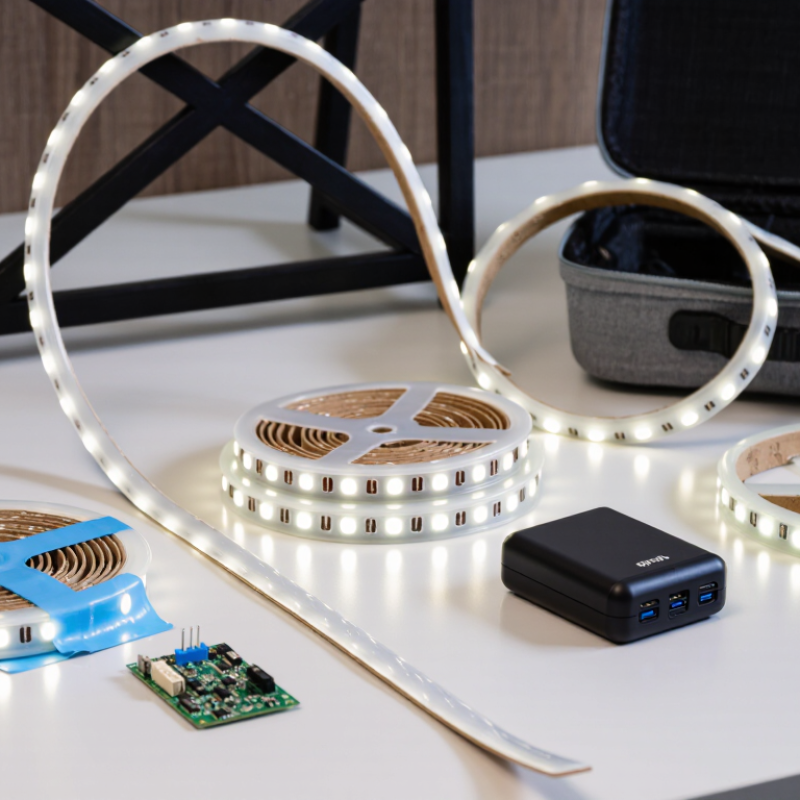
Portable light strips are flexible LED circuits designed to create movable, low-voltage illumination. Unlike fixed architectural strips, they combine a short LED ribbon, adhesive backing, a battery pack, and a small controller. Many models use USB-C or rechargeable lithium batteries. The controller adjusts brightness, color, or timing through buttons or wireless signals. A strip wrapped around a tent pole produces soft ambient light, while one under a portable shelf gives more focused illumination.
The U.S. Department of Energy reports that LED lighting can use at least 75% less energy and last up to 25 times longer than incandescent lighting. That advantage matters when battery capacity is limited. However, portable performance depends on more than LED efficiency. Battery size, copper trace quality, heat dissipation, and brightness settings all affect runtime. A 5-meter strip may look powerful on a specification sheet, yet its battery could last only a few hours at full output. Small details matter.
The International Energy Agency continues to identify efficient lighting as a practical route for reducing electricity demand. For global buyers, useful checks include color rendering, lumen output, charging protection, and ingress resistance. A CRI above 80 usually gives more natural colors, but it does not guarantee good light distribution. IP ratings also need careful reading. Water resistance is not waterproofing. I have found runtime claims especially difficult to compare because testing conditions differ. Suppliers should provide test methods, battery capacity, and measured brightness, not just attractive numbers.
Top Portable Light Strip Suppliers for Global Buyers - What Portable Light Strips Are and How They Work
| Evaluation Dimension | Relevant Specification or Data | How Portable Light Strips Work | What Global Buyers Should Verify |
|---|---|---|---|
| Product definition | A flexible printed circuit board fitted with surface-mounted LEDs, usually supplied on a reel and cut at marked points. | Electrical current flows through the circuit board to the LED packages, which convert electrical energy into visible light. | Confirm the strip construction, cutting marks, solder-pad layout, and whether connectors are included. |
| Portable power input | Common portable versions use 5 V USB power; 12 V and 24 V versions are also widely available but normally require a compatible battery pack or power supply. | A USB power bank, rechargeable battery pack, or external battery supplies low-voltage direct current to the strip. | Check voltage compatibility, connector type, polarity, over-current protection, and whether the power source is included. |
| LED package size | Common package designations include 3528, 2835, and 5050; the numbers generally indicate approximate package dimensions in hundredths of a millimetre, such as 3.5 × 2.8 mm for 3528. | The LED package contains semiconductor chips that emit light when forward current passes through them. | Request actual LED datasheets rather than judging brightness only by package size. |
| LED density | Common configurations include 30, 60, and 120 LEDs per metre. Higher density can reduce visible dark spots and improve uniformity. | More closely spaced LEDs distribute light more evenly, especially when the strip is installed in a shallow channel or close to a surface. | Compare LED count per metre, brightness per metre, power consumption per metre, and measured uniformity. |
| Typical power consumption | Many general-purpose strips are rated around 4.8–14.4 W per metre, although the actual value depends on LED type, density, colour, and brightness setting. | The power requirement determines the necessary battery capacity, wiring size, operating time, and heat-management method. | Use the supplier’s measured wattage at the intended brightness level and leave suitable capacity in the power source. |
| Colour temperature | Typical white-light options range from approximately 2700 K warm white to 6500 K daylight white. Tunable-white products can adjust between two or more colour-temperature ranges. | Different LED phosphor formulations produce different perceived white-light colours. | Request colour-temperature tolerance, colour consistency, and sample approval before mass production. |
| Colour rendering | CRI is used to describe how accurately light reveals colours. General products may be CRI 80 or higher, while higher-colour-quality versions can reach CRI 90 or above. | The LED spectrum affects how natural objects, fabrics, food, and skin tones appear under the strip. | Ask for test data identifying the measurement method, colour temperature, and actual CRI performance. |
| Colour modes and control | Single-colour strips use one LED colour; RGB strips mix red, green, and blue channels; addressable strips control individual LED sections or pixels. | A controller changes channel current or digital data signals to adjust colour, brightness, patterns, and effects. | Verify controller protocol, remote or app compatibility, control range, and data-direction requirements for addressable models. |
| Cutting and installation | Strips can normally be cut only at designated copper-pad intervals. The interval varies by circuit design and voltage. | Cutting at the marked point preserves the electrical circuit; cutting elsewhere can disable part of the strip. | Confirm the minimum cut length, adhesive backing quality, bend radius, connector options, and soldering requirements. |
| Ingress protection | IP20 provides no water protection; IP65 is dust-tight and protected against water jets; IP67 provides protection against temporary immersion under the applicable test conditions. | Silicone, epoxy, tubing, or sealed profiles can protect the circuit from dust and moisture, but they may affect heat dissipation and flexibility. | Request the tested IP rating, test standard, end-cap sealing method, and restrictions on submerged or outdoor use. |
| Thermal management | Higher-output strips generate more heat and may require an aluminium channel or another heat-spreading surface. | Excessive heat can reduce light output, shorten LED life, and accelerate degradation of the circuit and adhesive. | Check the recommended mounting surface, maximum continuous length, operating temperature, and derating guidance. |
| Battery runtime planning | Approximate runtime can be estimated as battery energy in watt-hours divided by strip power in watts, with allowance for conversion losses and controller consumption. | A longer strip, higher brightness, or animated colour effects increase energy consumption and reduce operating time. | Request measured runtime at the required brightness, not only the nominal battery capacity. |
| Supplier product range | A capable supplier may offer multiple voltages, LED densities, colours, waterproof grades, lengths, connectors, controllers, and battery options. | Different combinations allow the same basic lighting technology to be adapted for displays, furniture, events, vehicles, camping, and decorative applications. | Compare technical consistency across models, replacement-part availability, sample support, and production traceability. |
| Quality documentation | Useful documents include electrical specifications, LED or component datasheets, safety test reports, photometric data, and material declarations. | Documentation links the advertised performance to measurable electrical, optical, thermal, and safety characteristics. | Check that documents apply to the exact model, voltage, LED density, controller, and cable configuration being purchased. |
| International purchasing factors | Important commercial variables include sample availability, minimum order quantity, lead time, packaging, spare parts, warranty terms, and destination-market compliance. | Portable lighting systems contain several connected parts, so compatibility and after-sales support can be as important as the LED strip itself. | Confirm plug type, adapter input range, product labelling, carton protection, customs documents, warranty coverage, and replacement procedures. |