For a business making frequent short trips, transport choices affect time, costs, and daily workflow. A 48v Electric Scooter may suit site inspections, campus errands, property checks, or deliveries across a compact service area. Its voltage alone does not determine speed, range, or carrying capacity. Motor design, battery size, rider weight, terrain, and weather all matter.
Look beyond the headline specification. Ask suppliers for realistic range estimates under your expected load, charging times, warranty terms, and replacement-battery availability. Check whether the scooter can safely carry the tools or supplies your staff actually use. A route with smooth pavement and nearby charging is very different from one with steep hills and long gaps between stops. Small details count.
The business case should include more than purchase price. Consider staff training, protective equipment, maintenance, charging access, and downtime if a scooter needs repair. Keep a simple trial log: record route distance, battery use, delays, and rider feedback over several weeks. Results may surprise you. A scooter can simplify local trips, but it will not replace every vehicle or fit every workplace. That distinction is easy to overlook. Compare models against your real routes, confirm the manufacturer’s specifications, and involve the people who will ride and maintain the equipment. A careful pilot is often more useful than a confident guess.
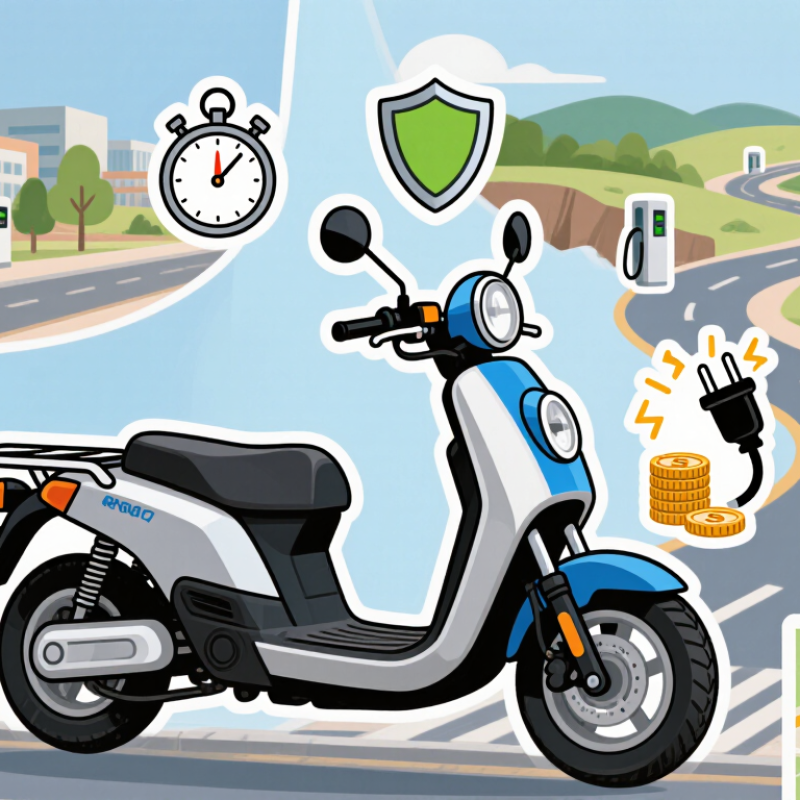
Why Choose a 48V Electric Scooter for Your Business?
Understanding the 48V Electric Scooter System
Understanding a 48V electric scooter starts with what the number actually means. Forty-eight volts is the battery pack’s nominal voltage, not a promise of speed or range. Motor output also depends on the controller, battery capacity, rider load, terrain, and tire pressure. A loaded scooter climbing a ramp may draw more current than it uses on flat pavement. That difference matters. Voltage and amp-hours together indicate stored energy; multiplying them gives an approximate watt-hour figure. Real-world range still varies. Cold mornings and frequent stops can reduce it.
The battery, motor, and controller must be designed to work together at 48 volts. Check the charger’s output specification, battery protection, connector condition, and stated operating limits. Do not assume higher voltage automatically means lower running costs. Compare rated load, daily distance, charging time, and battery replacement plans with your work schedule. For several short trips, charging between shifts may matter more than theoretical maximum range. Keep route and charge-level records for a few weeks. Those figures may challenge your first estimate. Published range tests rarely match a busy workplace exactly.
Estimated current required to deliver the same 1,000 W of electrical power at different nominal system voltages.
At the same power, a 48V system draws less current than a 36V system. Lower current can help reduce resistive losses in wiring; actual results depend on the battery, controller, motor, and operating conditions. Values are ideal estimates calculated using current = power ÷ voltage.
For a business scooter, 48V can support stronger acceleration under load, provided the motor and controller are designed for it. At equal power, a 48V system draws about 25% less current than a 36V system. Lower current can reduce heat and electrical losses, but it does not guarantee higher speed. Motor limits, controller settings, rider weight, and hills all matter. A 48V, 20Ah battery stores 960Wh; actual range still depends on stops, terrain, tire pressure, and payload.
Range and carrying capacity are different questions. More battery watt-hours may extend a route, while the frame, tires, brakes, and suspension determine safe payload. Check the maker’s rated load and test the scooter on your actual delivery route before buying a fleet. NACTO reported 157 million shared micromobility trips in 2023, showing how frequently urban vehicles may be used; that figure is not a range benchmark for individual scooters. A battery’s usable range should be measured under your own operating conditions.
Tips: Compare watt-hours, not voltage alone. Record distance, payload, and battery use across a typical shift. Keep one awkward detail in mind: frequent full-throttle starts can shrink range more than a slightly heavier load.
On a large campus, staff may travel between buildings several times each hour. A 48V electric scooter can help with short trips across private sites, such as resorts, warehouses, and industrial facilities. It can carry tools, documents, or small supplies when fitted with suitable storage. Less walking can also leave more time for hands-on tasks. That matters.
For facility teams, a scooter can support routine inspections. A worker might check a loading area, note a leaking pipe, and return to the maintenance room without crossing the site on foot. Security and cleaning teams may also find it useful for covering broad indoor or outdoor premises.
The right setup depends on floor surfaces, slopes, load needs, and daily distance. A 48V rating alone does not tell you how far a scooter will travel. Battery capacity, rider weight, weather, and stop-and-start use all affect real-world range.
Before buying, map a typical workday. Measure the longest route, identify safe charging locations, and check whether the scooter can carry its expected load. Keep it simple. A small pilot can reveal practical issues, including awkward storage or a charging point that is too far away. A spreadsheet may suggest a perfect fit; staff feedback can disagree. Review that feedback, along with maintenance needs, before expanding the fleet.
For a business, a 48V electric scooter can reduce day-to-day travel costs, but the savings depend on how it is used. A delivery route with frequent stops may consume more energy than a steady trip across a site. Track distance, charging time, and electricity use for several weeks before estimating costs. Small differences add up. The arithmetic can look cleaner than reality.
Charging is easiest to manage when scooters return to a consistent location and have time to recharge between shifts. A standard wall outlet may suit light use, while a busy fleet may need a charging schedule to avoid competing for outlets. Keep chargers dry, ventilated, and matched to the scooter’s specifications. Charging speed and range vary with battery condition, rider load, terrain, and temperature. Plan for that variation.
Maintenance is usually practical, not absent. Check tire pressure, brakes, lights, and fasteners on a regular schedule; worn tires can affect both safety and energy use. Record issues by scooter, so recurring problems do not disappear into busy shift notes. Batteries eventually lose capacity, and replacement costs can change the ownership calculation. That part is easy to underestimate. A small pilot can reveal whether charging routines and service intervals fit the actual workday.
| Business Consideration | Planning Estimate | Practical Details |
|---|---|---|
| Example battery capacity | 48 V × 20 Ah = 960 Wh (0.96 kWh) | Nominal battery capacity; usable energy and range vary with battery condition, load, speed, temperature, and terrain. |
| Typical real-world range | Approximately 25–40 km per charge | Use the lower end for route planning when carrying cargo, climbing hills, riding in cold weather, or making frequent stops. |
| Electricity needed for a full charge | Approximately 1.05–1.15 kWh from the wall | Allows for charging losses. Actual consumption depends on the charger, battery, and charging conditions. |
| Illustrative cost per full charge | About $0.16–$0.17 at $0.15 per kWh | Calculated from estimated wall energy use. Replace the electricity rate with your local commercial tariff. |
| Illustrative energy cost per 100 km | About $0.55 at a 30 km range per charge and $0.15 per kWh | Estimate only; route conditions and riding style can substantially change energy use and distance per charge. |
| Illustrative annual electricity cost | About $55 for 10,000 km per year | Based on the same 30 km-per-charge and $0.15-per-kWh assumptions. Excludes battery replacement and other operating expenses. |
| Charging time with a 2 A charger | Often approximately 8–10 hours from low charge | Charging may take longer near full capacity. Confirm the permitted charger specification in the scooter documentation. |
| Charging time with a 4 A charger | Often approximately 5–6 hours from low charge | Use a higher-current charger only if it is approved for the specific battery. Charging time varies by battery management system and temperature. |
| Workplace charging plan | Schedule charging between shifts or overnight | Provide a dry, ventilated charging area and suitable outlets. Avoid damaged cables and follow the battery and charger safety instructions. |
| Daily pre-use checks | Check tires, brakes, lights, controls, and visible damage | Regular checks can identify safety issues early. Keep a simple inspection log for vehicles used by multiple staff members. |
| Routine maintenance | Inspect and service according to the manufacturer’s schedule | Brake wear, tire condition, fasteners, and drivetrain needs depend on mileage, road surface, weather, and payload. |
| Battery care | Store and charge within the specified temperature range | Avoid prolonged storage at very low charge or in excessive heat. Battery life depends on usage, charging habits, and storage conditions. |
| Cost-planning note | Compare total cost, not just electricity use | Include purchase price, insurance where applicable, charging equipment, labor, tires, brake parts, downtime, and eventual battery replacement. |
| Assumptions: Cost examples use a 48 V, 20 Ah battery, estimated wall energy of 1.05–1.15 kWh per full charge, a 30 km planning range, and electricity at $0.15 per kWh. These are illustrative estimates, not guaranteed specifications or operating costs. | ||
Assess a 48V electric scooter against the work it will actually do. Voltage alone cannot predict range, hill-climbing ability, or daily operating cost. Check the battery’s watt-hour capacity, rated payload, and expected distance per shift. Then compare those figures with your busiest route, including stops, slopes, and carried equipment. Small details matter.
Look closely at charging time, battery access, braking performance, tire type, and replacement-part availability. A scooter may suit short urban trips but struggle with steep ramps or repeated heavy loads. Ask for test data under conditions similar to yours, not just an ideal range estimate. Numbers can mislead.
A short pilot can reveal what a specification sheet misses. Record distance, load, charging needs, and rider feedback over several workdays. Include wet pavement or rough sections if they are part of the route. One estimate will be wrong; revise it with real operating data. Also consider storage space and whether staff can handle routine checks safely. A 48V model is a practical choice only when its performance, upkeep, and capacity fit the business—not simply because the voltage sounds substantial.